



Breast Cancer


It starts as a typical day, until one small change in your breast becomes the moment that alters everything. Breast cancer often whispers before it screams, and knowing what to look for can save your life.
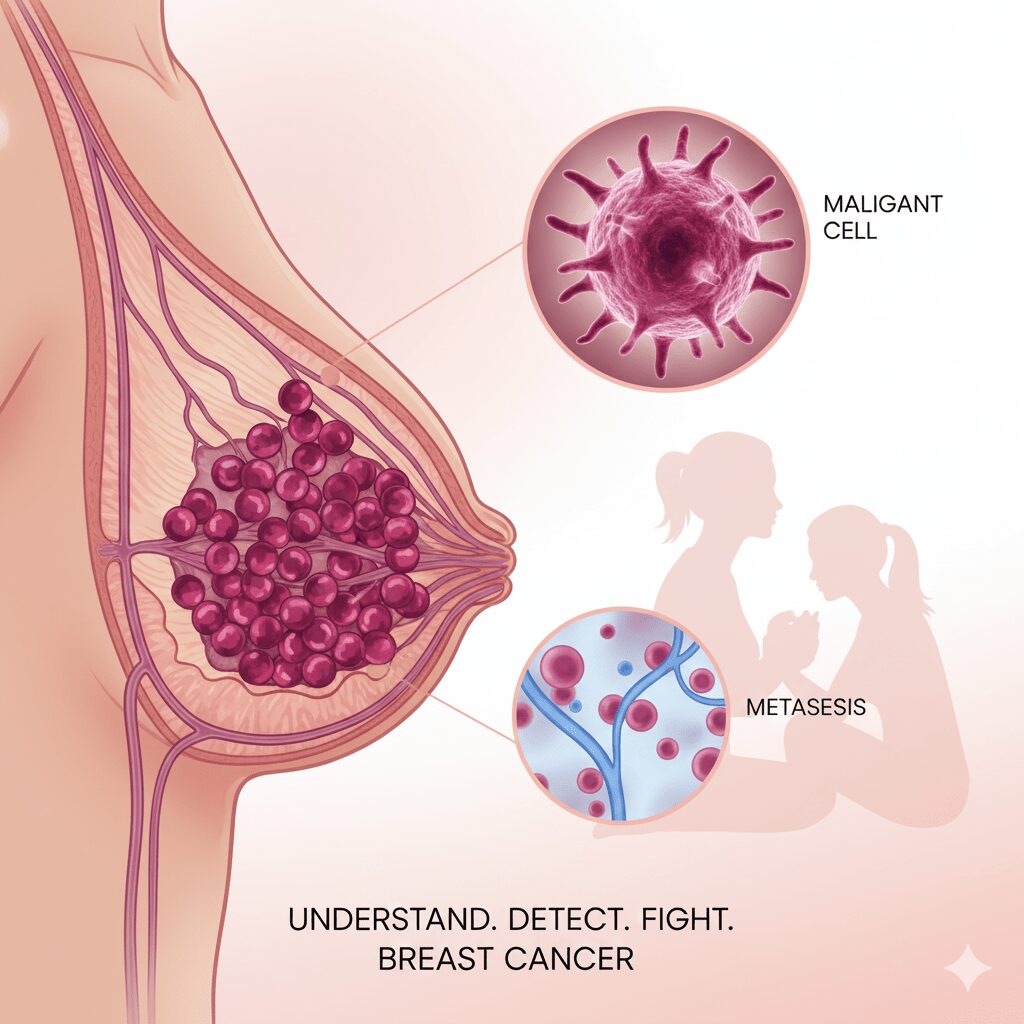
Breast cancer is a common type of cancer that begins when there is abnormal cell growth in the breast tissues. [1]
While it is most common in women, it can also affect men, as everyone is born with some breast tissue. In the U.S alone, the American Cancer Society notes that the condition accounts for about 30% or 1 in 3 of all new female cancers each year. [2]
According to the World Health Organization, breast cancer led to the death of about 670,000 individuals in 2022. [3] This clearly shows the disease has become a primary global health concern.
There are different types of breast cancer. However, the most common type depends on which breast cells become cancerous.
The most common types are:
- Invasive Ductal Carcinoma (IDC). IDC is the most common type of breast cancer. This condition begins in the cells lining the milk ducts and then spreads to the surrounding breast tissue. [4]
- Invasive Lobular Carcinoma (IPC). This type of cancer starts in the lobules. Lobules are the glands that produce milk. However, IPC is less common than IDC. [5]
Common Signs and Symptoms
Some warning signs of breast cancer are: [6]
- New lump in the breast
- Breast thickening or swelling
- Breast skin irritation
- Redness of the breast skin
- Nipple changes like inversion or discharge
- Persistent pain in the breast
It is important to note that early-stage breast cancer may not have any symptoms. This is why screenings are very crucial.
Screening can help identify the problem early and guide medication and recovery strategies.
Risk Factors
There are a number of factors, including environmental and lifestyle, that contribute to breast cancer.
These risk factors include:
- Age
- Family history
- Mutations in genes like BRCA1 and BRCA2.
- Alcohol intake
- Physical inactivity
- Radiation exposure
- Reproductive history
It’s also important to note that hormonal influences can be a risk of breast cancer. Hormonal influences like early menstruation, late menopause, or hormone therapy play a significant role.
Always talk to your doctor if you suspect you are at risk of the condition. Your healthcare provider will provide guidance and issue preventative and coping strategies.
Importance of Early Detection
Early detection of breast cancer is essential as it can improve survival rates and also allow for less invasive treatment options.
Early-stage cancer often has more varied treatment options, which may include less aggressive procedures like a lumpectomy instead of a mastectomy, or targeted radiation instead of extensive chemotherapy.
A comprehensive approach to breast health includes a combination of self-awareness and professional screenings. These include:
- Self-breast exams (BSE). This type of screening involves a woman regularly checking their own breasts to become familiar with their everyday look and feel. This makes it easier for them to notice any unusual changes
- Clinical breast exams (CBE). This is where a healthcare professional does a physical examination of the breasts and underarm areas as part of a routine checkup.
- A low-dose X-ray of the breast tissue is the gold standard for screening. This procedure can detect tumors or microcalcifications too small to be felt by hand, often before symptoms appear.
Treatment Options
Breast cancer treatment options include:
- Chemotherapy
- Immunotherapy
- Lumpectomy
- Mastectomy
- Lymph node surgery
It's also important to note that your condition will significantly influence the type of treatment options recommended by your healthcare provider. For early-stage breast cancer, your healthcare expert might recommend targeted treatment.
However, for an advanced stage of cancer, your healthcare expert may recommend treatments like chemotherapy or immunotherapy.
Prevention and Lifestyle Tips
Your lifestyle choices greatly influence your health status. Also, environmental factors affect your health.
Here are actionable tips you can incorporate into your daily routine to maintain good health, which is also crucial to prevent cancer:
- Maintain a healthy weight
- Engage in physical activity
- Limit alcohol intake
- If you have a family history, discuss the risk with your doctor
Emotional + Social Support
It’s entirely normal for you to feel many strong emotions when dealing with breast cancer. You might experience fear, anxiety, anger, sadness, or worry about the future. These feelings can be overwhelming, and they’re a natural part of what you’re going through.
The emotional stress can be just as challenging as the physical treatment. It may affect how you see yourself, how you connect with others, and how you feel day to day. Allowing yourself to recognize these feelings without judging them is an essential first step toward coping and healing.
Accessing strong emotional and social support networks is an essential component of comprehensive care and recovery.
You can seek social support from:
- Family and friends
- Professional counseling
- Survivor groups and peer support
Early detection saves lives. Take time today to check your breasts, know what’s normal, and schedule your routine screening. Encourage the women around you to do the same. Awareness is not just knowledge; it’s protection. Your action today can make a real difference for your health and the health of those you love.
Sources
- Mayo Clinic. Breast cancer. Mayo Clinic. Published January 10, 2025. https://www.mayoclinic.org/diseases-conditions/breast-cancer/symptoms-causes/syc-20352470
- American Cancer Society. Key statistics for breast cancer. American Cancer Society. Published January 12, 2024. https://www.cancer.org/cancer/types/breast-cancer/about/how-common-is-breast-cancer.html
- WHO. Breast cancer. World Health Organization. Published August 14, 2025. https://www.who.int/news-room/fact-sheets/detail/breast-cancer
- Cleveland Clinic. Invasive (Infiltrating) Ductal Carcinoma: Grades, Treatments & Prognosis. Cleveland Clinic. Published November 29, 2021. https://my.clevelandclinic.org/health/diseases/22117-invasive-ductal-carcinoma-idc
- Cleveland Clinic. Lobular Breast Cancer: Causes, Tests, and Treatment. Cleveland Clinic. Published September 20, 2022. https://my.clevelandclinic.org/health/diseases/21180-lobular-breast-cancer
- Centers for Disease Control and Prevention. Symptoms of Breast Cancer. Breast Cancer. Published February 21, 2024. https://www.cdc.gov/breast-cancer/symptoms/index.html