




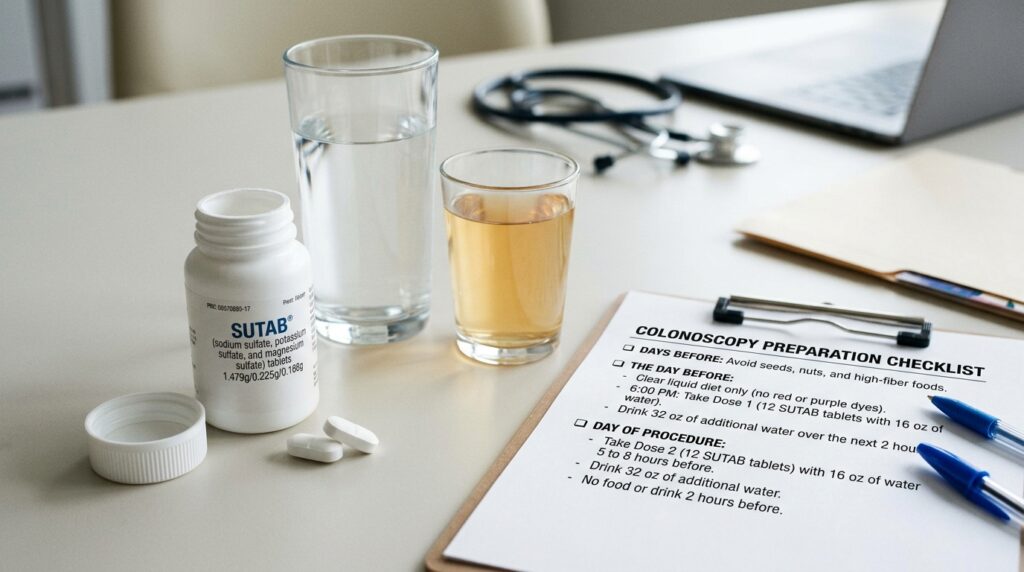
SUTAB Colonoscopy Prep: Instructions, Diet, Timing, and Tips


SUTAB colonoscopy prep uses tablets plus water to clean the colon before a colonoscopy. The standard SUTAB regimen consists of 24 tablets taken in two doses of 12 tablets each, with water consumed with and after each dose. The goal is to remove stool so your doctor can clearly examine the lining of the colon.
Your gastroenterologist or endoscopy center may give you specific timing, diet, medication, and fasting instructions. Follow those instructions over any general schedule you find online, because preparation protocols can vary depending on your procedure time and medical history.
What Is SUTAB?
SUTAB is a prescription bowel preparation used by adults before colonoscopy.
It contains:
- Sodium sulfate
- Magnesium sulfate
- Potassium chloride
Unlike liquid bowel preparations that require drinking a large volume of laxative solution, SUTAB is taken as tablets with water. It is an osmotic laxative that draws water into the bowel to help produce bowel movements and clear the colon.
A complete preparation requires two bottles of 12 tablets, for a total of 24 tablets.
How Does SUTAB Colonoscopy Prep Work?
SUTAB works by increasing the amount of water in your intestines.
This causes frequent bowel movements that gradually empty the colon.
The preparation is usually divided into two doses. The first dose is taken the evening before the colonoscopy, while the second dose is taken later, often on the morning of the procedure. The exact timing should come from your healthcare provider.
Splitting the preparation helps keep the colon clean closer to the time of the examination.
SUTAB Colonoscopy Prep Instructions
The FDA-approved regimen uses two doses of 12 tablets.
First Dose
Your first dose is generally taken the evening before your colonoscopy.
You will:
- Open the first bottle containing 12 tablets.
- Remove and discard the desiccant.
- Fill the supplied container with 16 ounces of water.
- Swallow the tablets with water according to your prescribed instructions.
- Drink the additional water required after the tablets.
The official SUTAB instructions require an additional 32 ounces of water after each dose, in addition to the water taken with the tablets.
Do not rush the water if you become nauseated or uncomfortable. The manufacturer advises slowing or pausing additional water intake until symptoms improve.
Second Dose
The second dose uses the remaining 12 tablets.
It is generally taken on the day of the colonoscopy according to a timing schedule provided by your endoscopy team.
The exact time matters because your colon needs to remain clean while also allowing enough time for the bowel preparation to work before the procedure.
The official labeling says the complete SUTAB regimen should be finished with the required water at least two hours before the colonoscopy. Your facility may give you a stricter fasting or arrival-time instruction.
What Can You Eat Before SUTAB?
Diet instructions can vary between endoscopy centers.
The official SUTAB instructions allow a low-residue breakfast the day before the colonoscopy, followed by clear liquids, unless your doctor gives you different instructions. Examples include eggs, white bread, yogurt, cottage cheese, grits, coffee, and tea without milk or cream.
Some medical centers instead recommend starting a clear-liquid diet earlier.
Therefore, use your own procedure instructions as the final authority.
What Can You Drink During SUTAB Prep?
Clear liquids are important because SUTAB can cause substantial fluid loss.
Depending on your doctor's instructions, acceptable clear liquids may include:
- Water
- Clear broth
- Apple juice without pulp
- White grape juice
- Black coffee
- Tea without milk or cream
- Clear soda
- Sports drinks
- Gelatin without fruit
Avoid liquids that your instructions prohibit.
The official SUTAB guidance specifically says to avoid red and purple liquids and alcohol.
If your medical center provides a different list, follow its instructions.
Why Is Hydration So Important?
SUTAB causes significant fluid loss through repeated bowel movements.
Inadequate fluid replacement can lead to dehydration and electrolyte abnormalities.
Symptoms of dehydration can include:
- Dry mouth
- Dizziness
- Weakness
- Very little urine
- Dark urine
- Excessive thirst
- Feeling faint
For more information, see our guide to signs of dehydration.
The SUTAB prescribing information warns that serious fluid and electrolyte changes can potentially cause kidney problems, abnormal heart rhythms, and seizures. Adequate hydration before, during, and after the preparation is therefore important.
What Should Your Stool Look Like?
As the preparation works, bowel movements should become progressively more watery and lighter.
By the end of the preparation, the stool is generally expected to be clear or yellow liquid without solid pieces.
The exact description may vary slightly between endoscopy centers.
If your bowel movements remain dark, thick, or contain substantial solid material near the procedure, contact your endoscopy team for instructions rather than taking additional laxatives on your own.
What Are Common SUTAB Side Effects?
Frequent bowel movements are expected.
Other common reactions can include:
- Nausea
- Bloating
- Vomiting
- Abdominal discomfort
- Cramping
- Upper abdominal pain
These are listed among the common adverse reactions in the official prescribing information.
If nausea develops, slowing the rate at which you drink the additional water may help. If you continue vomiting or cannot keep fluids down, contact your healthcare provider.
What Medications Should You Take With SUTAB?
Medication instructions are particularly important because bowel preparation can affect how medicines are absorbed.
The official instructions say not to take oral medications within one hour before starting each SUTAB dose. Certain medicines, including iron and some antibiotics and other drugs, require additional timing precautions.
Blood thinners and diabetes medications may require individualized instructions.
Do not stop prescription medications on your own.
Instead, ask your gastroenterologist or the doctor who prescribed the medication what you should do before the colonoscopy.
Some centers also have specific instructions for GLP-1 medications, iron supplements, fiber supplements, and other medicines. These recommendations can differ between facilities.
What If You Take Diabetes Medication?
Diabetes requires special planning because you may be eating very little or only drinking clear liquids while your medication continues to lower blood glucose.
Your diabetes medication may need to be adjusted.
Do not change insulin or other diabetes medication doses without instructions from your healthcare team.
Contact your gastroenterologist and diabetes clinician before the preparation if you have not received specific instructions.
What If You Take Blood Thinners?
Do not stop blood thinners simply because you are having a colonoscopy.
Some procedures require temporary changes to anticoagulant or antiplatelet medication, while others may not.
The decision depends on:
- The medication
- Why you take it
- Your bleeding risk
- The planned procedure
- Your individual medical history
Ask your prescribing clinician and endoscopy team well before the procedure.
What If You Feel Nauseous During SUTAB Prep?
Nausea can occur during bowel preparation.
If you become nauseated:
- Slow down the additional water.
- Pause briefly if your instructions allow.
- Resume more slowly when you feel better.
- Contact your healthcare provider if vomiting continues.
Do not simply abandon the preparation without contacting your medical team because an incomplete bowel preparation can make the colonoscopy less effective or lead to rescheduling.
If nausea is a concern, you may also find our guide to why you feel nauseous in the morning useful for understanding other possible causes of nausea.
What If You Vomit After Taking SUTAB?
Occasional nausea can occur, but repeated vomiting is more concerning.
If you vomit shortly after taking the tablets, your preparation may not work as intended.
Contact your endoscopy team for instructions rather than automatically repeating the dose.
The SUTAB safety information advises contacting your healthcare provider if you develop significant vomiting or signs of dehydration.
Can You Sleep During SUTAB Prep?
You may be able to sleep between bowel movements, but the timing varies significantly from person to person.
Expect frequent trips to the bathroom once the preparation begins.
It can help to:
- Stay close to a bathroom
- Keep toilet paper or gentle wipes nearby
- Use a skin-protective barrier if needed
- Keep clear liquids available
- Follow your dosing schedule carefully
Repeated wiping can irritate the skin around the anus, so gentle cleaning can make the preparation more comfortable.
What Happens If SUTAB Does Not Work?
If you have taken the preparation correctly but are not having bowel movements, contact your endoscopy team.
Do not automatically add another laxative unless your healthcare provider specifically tells you to do so.
Some centers have their own rescue instructions, but these should be followed only when provided by the medical team.
Who Should Not Take SUTAB?
SUTAB is not appropriate for everyone.
The prescribing information lists contraindications including:
- Gastrointestinal obstruction or ileus
- Bowel perforation
- Toxic colitis
- Toxic megacolon
- Gastric retention
- Allergy to an ingredient in SUTAB
Your doctor should also know if you have kidney problems, heart problems, electrolyte abnormalities, or conditions that may increase your risk of dehydration.
When Should You Call Your Doctor?
Contact your healthcare provider if you experience:
- Persistent vomiting
- Severe abdominal pain
- Severe bloating
- Signs of dehydration
- Very little urine
- Fainting
- Significant weakness
- Inability to complete the preparation
- No bowel movement despite taking the preparation
Do not wait until the day of the procedure if you have concerns that could affect your preparation.
When Is SUTAB an Emergency?
Seek urgent medical care for severe symptoms such as:
- Fainting
- Severe weakness
- Confusion
- Severe or persistent abdominal pain
- Difficulty breathing
- Signs of a serious allergic reaction
- Seizures
- Severe dehydration
The official safety information warns that serious fluid and electrolyte abnormalities can cause kidney problems, abnormal heart rhythms, and seizures.
Tips for Making SUTAB Prep Easier
A little planning can make the process more manageable.
Prepare Your Bathroom
Keep the bathroom stocked with soft toilet paper and gentle wipes.
Stay Hydrated
Have approved clear liquids ready before starting.
Follow Your Timing
Set alarms if necessary so you do not accidentally delay the second dose.
Do Not Improvise
Do not add laxatives, change medication instructions, or alter fasting times without speaking with your healthcare team.
Plan Your Ride
Sedation is commonly used for colonoscopy, so arrange transportation according to your facility's requirements. Some centers require a responsible adult to accompany you home.
Conclusion
A successful SUTAB colonoscopy prep depends on taking both doses correctly, drinking the required water and clear liquids, following the appropriate diet, and following your endoscopy team's medication and fasting instructions.
The standard SUTAB regimen contains 24 tablets divided into two doses of 12 tablets. Each dose requires water with the tablets and additional water afterward.
Nausea, bloating, cramping, vomiting, and frequent bowel movements can occur during preparation. However, significant vomiting, severe abdominal pain, or signs of dehydration require medical advice.
Most importantly, do not use a generic internet schedule instead of the instructions provided for your specific colonoscopy. Different centers can use different timing and fasting protocols. If your instructions conflict with information in this article, follow your healthcare provider's instructions.
For additional preparation safety, keep our guide to signs of dehydration available while completing the prep.
Frequently Asked Questions
How Many SUTAB Tablets Do You Take for a Colonoscopy?
The standard regimen requires 24 tablets total. You take 12 tablets for the first dose and 12 tablets for the second dose.
How Much Water Do You Drink With SUTAB?
Each dose is taken with 16 ounces of water, followed by two additional 16-ounce portions of water. That means 32 additional ounces after each dose.
What Can I Drink During SUTAB Prep?
Approved clear liquids may include water, clear broth, pulp-free juice, black coffee, tea without milk or cream, and clear soda. Avoid red or purple liquids and alcohol unless your medical team gives different instructions.
When Should I Take the Second Dose of SUTAB?
The second dose is generally taken on the day of the colonoscopy, but the exact timing depends on your procedure and your endoscopy center's instructions. Do not substitute a generic schedule for your doctor's instructions.
What Should My Stool Look Like Before a Colonoscopy?
Your bowel movements should eventually become watery and clear or yellow, without solid pieces. If your stool is still dark or contains substantial solid material, contact your endoscopy team.
What If I Vomit After Taking SUTAB?
Pause or slow the additional water if you become nauseated. If vomiting is significant or continues, contact your healthcare provider for instructions.
Can I Take My Regular Medications With SUTAB?
Some medications can be taken, while others may need to be temporarily adjusted. Oral medication should not be taken within one hour before starting each SUTAB dose, and certain medicines require additional timing precautions. Always follow your healthcare team's medication instructions.
What Happens If SUTAB Does Not Fully Clean My Colon?
Contact your endoscopy team if you are not having bowel movements or your stool remains far from clear after completing the preparation. Do not take additional laxatives unless your healthcare provider specifically instructs you to.
