




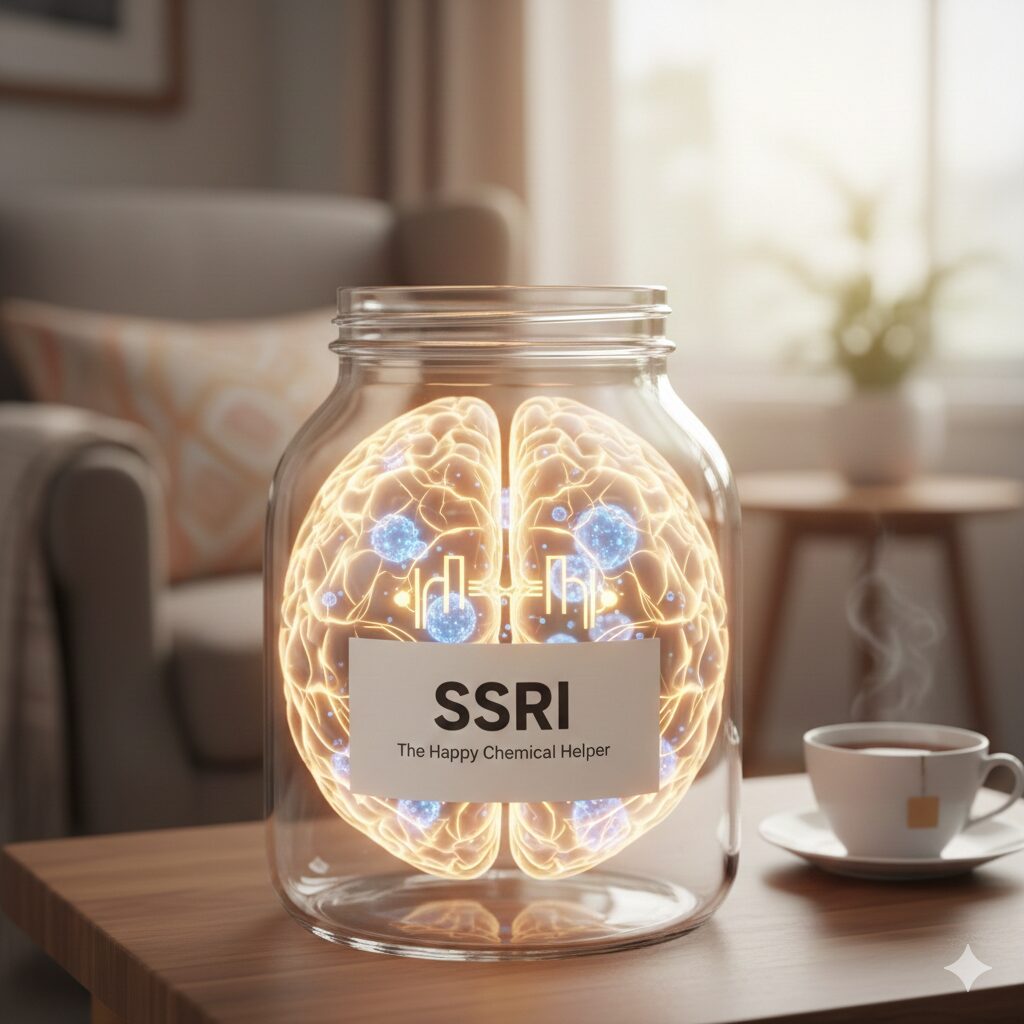
How Do SSRIs Work? A Simple Guide to the Most Common Antidepressants


What are SSRIs? We explain how these common antidepressants work to treat anxiety and depression, their side effects, and why they take time to kick in.
The “Happy Chemical” Helper: Understanding SSRIs
Imagine you are trying to send a text message to a friend, but your phone keeps losing the signal before the message sends. You feel frustrated and disconnected. This is a little bit like what happens inside your brain when you have depression or anxiety. Your brain cells are trying to send “happy messages” to each other, but the connection is weak.
For millions of people, the solution to fixing this connection is a type of medicine called an SSRI.
You have probably heard of them before. Brand names like Prozac, Zoloft, and Lexapro are well-known. But what do they actually do?
What is an SSRI?
SSRI stands for Selective Serotonin Reuptake Inhibitor.
That is a very long, complicated name. To keep it simple, think of them as “Serotonin Boosters.” They are the most commonly prescribed type of antidepressant medicine because they are generally safe and have fewer side effects than older drugs.
The Mayo Clinic notes that SSRIs are often the first choice for doctors because they are effective and easier for most people to tolerate.
How Do They Work?
To understand the medicine, you have to understand a chemical in your brain called Serotonin.
Serotonin is a messenger. It carries signals between your brain cells that help regulate your mood, sleep, and emotions. When you have enough serotonin hanging around, you feel stable and calm.
Here is the problem: After your brain releases serotonin to send a message, it quickly sucks it back up to recycle it. This process is called “reuptake.”
In some people, the brain sucks the serotonin back up too fast. This means there is not enough left over to keep your mood happy.
This is where the SSRI helps. The medicine acts like a gatekeeper. It blocks your brain from recycling the serotonin too quickly. This leaves more serotonin floating around in the space between your brain cells. Because more serotonin is available, the messages can get through clearly, helping to lift your mood.
According to the National Health Service (NHS), while we do not know the exact cause of depression, increasing serotonin levels appears to help improve symptoms and make people more responsive to therapy.
What Do They Treat?
While most people think of them as “depression pills,” doctors use them for many different mental health struggles.
- Depression: To lift the “dark cloud.”
- Anxiety: To stop constant worrying.
- Panic Disorders: To prevent sudden panic attacks.
- OCD (Obsessive-Compulsive Disorder): To help control repetitive thoughts.
Side Effects: What to Expect
SSRI medicines are safe for most people, but like all drugs, they can cause changes in your body. The good news is that most side effects are mild and go away after a few weeks as your body gets used to the medicine.
Common side effects include:
- Feeling sick to your stomach (Nausea)
- Trouble sleeping or feeling sleepy during the day
- Dizziness
- Dry mouth
- Sexual problems (lower desire)
Cleveland Clinic experts state that while side effects are common, they usually improve within the first 1 to 4 weeks of treatment.
Why You Must Be Patient
This is the hardest part. SSRIs are not like aspirin. If you have a headache, you take aspirin, and the pain stops in 30 minutes. SSRIs do not work that fast.
You might take the pill every day for 2 to 6 weeks before you start to feel better. Many people give up too soon because they think it is not working. It is essential to keep taking it so the medicine has time to build up in your system.
A Serious Warning
You should never stop taking this medicine suddenly. If you just quit cold turkey, you can get sick. You might feel dizzy, get headaches, or feel like you have the flu. This is called “discontinuation syndrome.”
Harvard Health advises that you should always talk to your doctor to lower your dose slowly over time, rather than stopping all at once.
The Bottom Line
SSRIs are a tool, not a magic wand. They help balance the chemicals in your brain so you can handle life better. If you need help, talk to your doctor. There is no shame in taking medicine to help your brain send the right messages.
Frequently Asked Questions
Will I have to take these pills forever?
Not necessarily. Many people only need SSRIs for a short time to get through a difficult period. Doctors often recommend staying on the medication for 6 to 12 months after you start feeling better to prevent the depression from coming back.
Will this medicine change my personality?
No. A common fear is that antidepressants will turn you into a “zombie” or make you feel fake. This should not happen. When SSRIs work correctly, they do not change who you are; they remove the heavy weight of depression or anxiety. You should still feel like yourself, just lighter and more able to handle your day.
Can I drink alcohol while taking SSRIs?
It is usually best to avoid it. Alcohol is a “depressant,” which means it does the exact opposite of what your medicine is trying to do. Drinking can make your depression worse and can also make the side effects of the drug, like dizziness and drowsiness, much stronger.
Sources
Mayo Clinic. Selective serotonin reuptake inhibitors (SSRIs). Mayo Clinic. Published September 11, 2024. https://www.mayoclinic.org/diseases-conditions/depression/in-depth/ssris/art-20044825
NHS. Treatment – Depression in adults. nhs.uk. Published 2023. https://www.nhs.uk/mental-health/conditions/depression-in-adults/treatment/
Cleveland Clinic. Antidepressants. Cleveland Clinic. Published March 1, 2023. https://my.clevelandclinic.org/health/treatments/9301-antidepressants-depression-medication
Salamon M. Tapering off antidepressants sensibly. Harvard Health. Published August 1, 2022. https://www.health.harvard.edu/mind-and-mood/tapering-off-antidepressants-sensibly




2 thoughts on “How Do SSRIs Work? A Simple Guide to the Most Common Antidepressants”
Comments are closed.