




GHK-Cu Peptide: Copper and Tissue-Repair Research


A small tripeptide isolated from human blood plasma in the early 1970s has kept a place in the skin-science and wound-repair literature for five decades. That peptide is GHK, and the form most often studied in laboratories is its copper complex. The pairing of a short amino-acid sequence with a single copper ion turns out to be chemically specific and biologically interesting, which is why the GHK-Cu peptide still appears in cell-culture and animal work on collagen, extracellular-matrix remodeling, and antioxidant signaling.
What follows is an evidence-aware summary of what the compound is, what the preclinical literature actually reports, and how it is handled as a research material. None of this is medical guidance. GHK-Cu is a research compound, and the discussion here is framed for laboratory use only.
What GHK-Cu actually is?
GHK stands for glycyl-L-histidyl-L-lysine, a tripeptide built from three amino acids in sequence: glycine, histidine, and lysine. On its own, GHK is just that short peptide. The name GHK-Cu refers to the complex it forms when GHK binds a copper(II) ion. The histidine and terminal amine groups of the peptide coordinate the copper, holding it in a stable arrangement that the peptide alone does not have.
This distinction matters more than it might seem. Much of the biological activity attributed to GHK in the literature depends on copper. GHK has a high affinity for copper(II), and researchers describe it as a carrier that can pick up and shuttle the ion. Copper is a cofactor for several enzymes relevant to connective tissue, including lysyl oxidase, which crosslinks collagen and elastin, and superoxide dismutase, one of the cell’s antioxidant enzymes. So when a study refers to “GHK-Cu,” it is usually studying the peptide and its bound metal together as a functional unit, not the free peptide.
Endogenous GHK is not exotic. It has been identified in human plasma, and reports also describe its presence in saliva and urine. The literature frequently notes that plasma levels of GHK are highest in younger adults and are described as declining with age. That age-related decline is one reason the peptide drew interest as a possible signal tied to tissue maintenance, though the relationship between circulating levels and any specific function in humans remains an area of study rather than settled fact.
The mechanisms studied in preclinical work
The most consistent theme across the GHK-Cu literature is connective-tissue remodeling. In cell-culture systems, GHK-Cu has been reported to influence the production of collagen and other components of the extracellular matrix, including glycosaminoglycans and proteoglycans. These molecules form the structural scaffold that fibroblasts build and maintain in skin and other tissues. Work in fibroblast cultures has examined how the peptide affects the balance between building matrix and breaking it down, including effects on matrix metalloproteinases and their inhibitors.
A second line of research looks at wound-healing models. In animal studies, copper peptides including GHK-Cu have been applied to experimental wounds and studied for effects on the rate and quality of tissue repair, including angiogenesis, the growth of new small blood vessels that supply a healing site. These are preclinical models, and the results describe biological responses in animals and cells rather than demonstrated clinical outcomes in people.
There is also a body of gene-expression work. Analyses using cultured human cells have reported that GHK can shift the activity of a large number of genes, with the peptide associated with changes across pathways involved in tissue remodeling, inflammation signaling, and antioxidant responses. The antioxidant angle connects back to copper: the metal’s role in superoxide dismutase, and separate reports that GHK-Cu can influence oxidative markers and iron handling in experimental systems, are part of why the complex is studied beyond collagen alone.
It is worth keeping the framing honest here. Much of this evidence comes from in vitro systems and animal models, and mechanistic findings in a dish do not automatically translate to a living organism, let alone to humans. Early research suggests a coherent picture around matrix biology and copper-dependent enzymes, but “suggests” is the right verb. The peptide is a tool for studying these pathways, not a validated intervention.
GHK versus the copper complex
Because the two names appear almost interchangeably in casual writing, it helps to be precise. GHK is the peptide. GHK-Cu is the peptide holding a copper ion. Researchers sometimes work with the apo-peptide (copper-free) and let it acquire copper from the surrounding medium, and sometimes work with the pre-formed complex so that copper content is defined. If a protocol or a product is ambiguous about which form it contains, that ambiguity can affect reproducibility, since the copper is doing real chemical work in most of the reported mechanisms. Reading a specification sheet with this distinction in mind is a basic quality step.
Research forms and handling
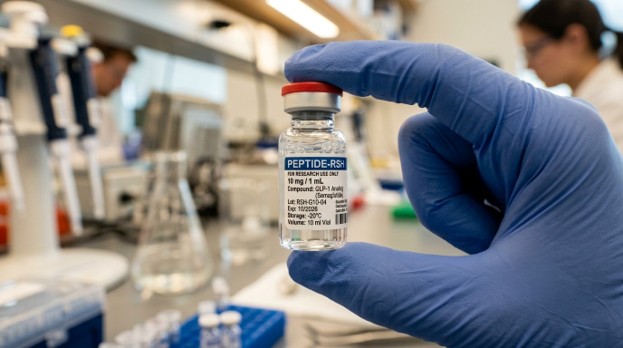
For laboratory purposes, GHK-Cu is typically supplied as a lyophilized (freeze-dried) powder. The complex has a characteristic deep blue color from the coordinated copper, which is a rough visual cue but not a substitute for analytical testing. Some suppliers also offer topical research solutions prepared for surface application in experimental settings.
Handling notes follow from the chemistry. Peptides in general are sensitive to heat, and reconstituted solutions are less stable than dry powder, so the lyophilized form is usually stored cold and reconstituted only when needed. Copper complexes can also be sensitive to light and to oxidation, so amber vials, minimal air exposure, and prompt use of reconstituted material are common precautions. Repeated freeze-thaw cycles are generally avoided because they can degrade peptide integrity. These are standard research-handling practices rather than instructions for any human use.
Quality markers to check
The value of any preclinical result depends on the material behind it, and copper peptides raise a specific concern: both the peptide sequence and the copper content need to be right. A few markers separate research-grade material from the rest.
Purity is the first. A certificate of analysis (COA) should report purity, usually by high-performance liquid chromatography (HPLC), and identity confirmation, typically by mass spectrometry, so the stated sequence and mass match what is in the vial. Independent third-party testing adds a layer of confidence that the COA is not simply a self-reported figure. For a copper complex specifically, documentation that addresses copper content and the correct stoichiometry is a reasonable thing to expect, since a “GHK” product without properly coordinated copper is a different material than “GHK-Cu.”
Sourcing transparency rounds it out: clear labeling, lot numbers, and honest research-use framing. Anyone who chooses to buy peptides online for laboratory work benefits from suppliers who publish this documentation rather than asking buyers to take purity on faith.
Frequently asked questions
Is GHK-Cu the same as GHK?
No. GHK is the tripeptide glycyl-L-histidyl-L-lysine. GHK-Cu is that peptide bound to a copper(II) ion. Most of the biological activity described in the literature depends on the copper, so the two are not interchangeable in practice.
Where does GHK come from in the body?
GHK has been identified in human plasma, with reports also describing it in saliva and urine. The literature commonly notes that plasma levels are higher in younger adults and are described as declining with age.
What has GHK-Cu been studied for?
Mainly connective-tissue and skin biology: collagen and extracellular-matrix production, wound-healing models in animals, angiogenesis, and antioxidant and gene-expression effects in cell studies. This work is preclinical and does not establish clinical benefit in humans.
Why is copper important?
Copper is a cofactor for enzymes such as lysyl oxidase, which crosslinks collagen and elastin, and superoxide dismutase, an antioxidant enzyme. GHK’s ability to bind and carry copper is central to how researchers explain many of its reported effects.
A note on use
GHK-Cu is intended for research use only. It is not a medicine, and nothing above should be read as clinical, diagnostic, or treatment advice.
