



The New Frontier of Real-World Evidence (RWE): Why Your Clinical Data is More Valuable Than Ever


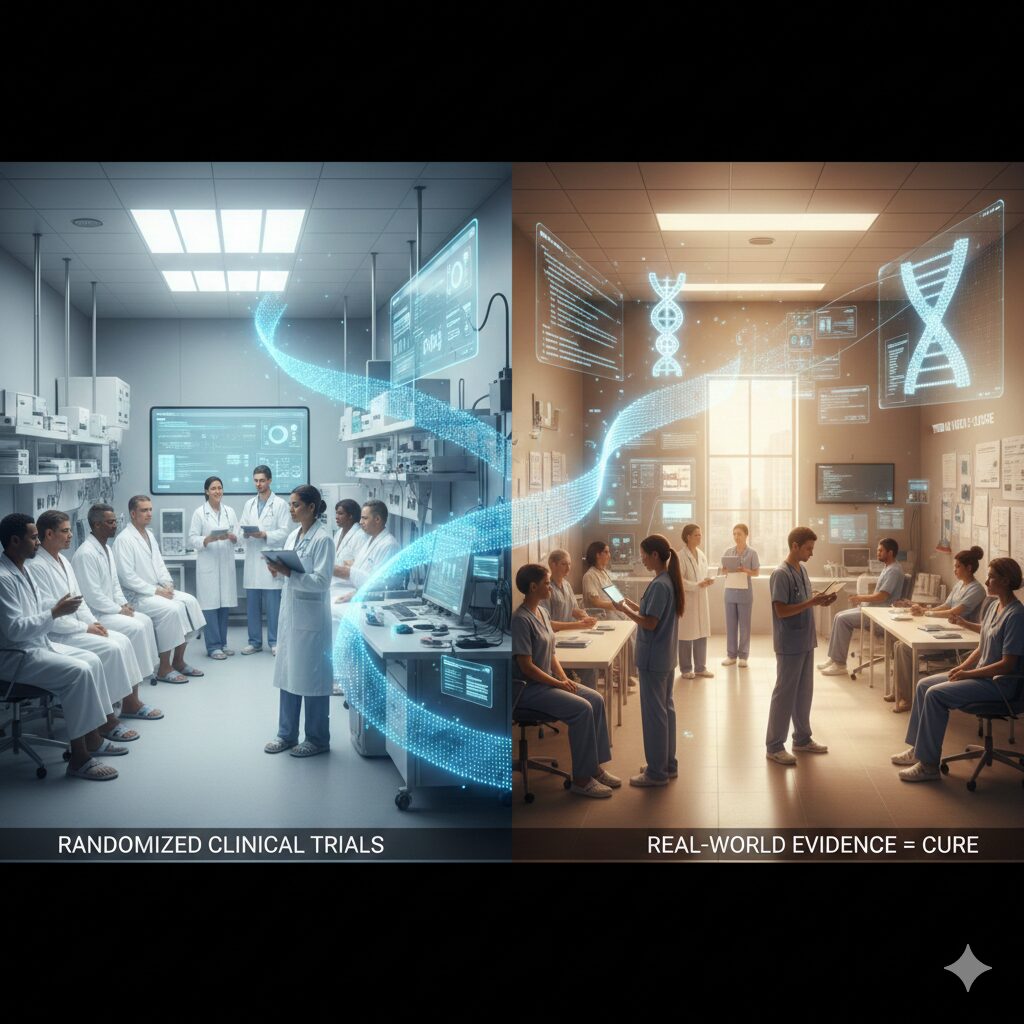
For decades, the gold standard for testing new medicines was the randomized clinical trial. You know the drill: a strictly controlled environment, carefully selected patients, and rigorous monitoring.
While this method remains vital, a significant shift is underway in healthcare. The notes you take, the electronic health records (EHRs) you update, and the daily observations you make are becoming just as powerful as those traditional trials.
This concept, called Real-World Evidence (RWE), is transforming how we understand medicine. For clinics and healthcare providers, this means your daily data entry is no longer just paperwork; it is a potential key to curing diseases.
What is Real-World Evidence?
In simple terms, Real-World Data (RWD) is the information collected during routine patient care. It is not data from a special experiment; it is data from real life. When this data is analyzed to prove that a treatment works or is safe, it becomes Real-World Evidence (RWE) according to PubMed Central.
The Food and Drug Administration (FDA) defines Real-World Data as data regarding patient health status and the delivery of health care routinely collected from a variety of sources. This includes electronic health records, claims and billing activities, and even patient-generated data from home use settings.
Why does this matter now? Because the government is listening. The FDA is actively using this everyday data to approve new uses for existing drugs and to monitor safety. This is a massive change. It means the “messy” reality of how drugs work in actual clinics is finally being counted alongside the “clean” world of clinical trials.
The Shift: Why the FDA Wants Your Data
The push for RWE is not just a trend; it is a regulatory evolution. According to the FDA, Congress passed the 21st Century Cures Act to help accelerate medical product development. This law specifically focuses on the use of these real-world data types to support regulatory decision-making.
Think about it this way: A clinical trial might tell us how a heart medication works on a 40-year-old male with no other health issues. But what happens when you give that same medication to a 70-year-old woman who also has diabetes and high blood pressure? Clinical trials often exclude these complex patients. Real-world data includes them.
The National Institutes of Health (NIH) notes that real-world evidence can help answer questions that clinical trials cannot, such as how treatments affect diverse populations over long periods. By reviewing your clinic’s data, researchers can see the complete picture of patient health.
From Data Entry to Lifesaving Research
This is where your clinic comes in. For your data to be valid, it has to be “clean.” Clean data means accurate, complete, and standardized entries. If a doctor writes “patient felt better” in a free-text note, a computer might struggle to analyze that.
But if they record a specific pain score or a standardized symptom improvement, that data becomes a powerful statistic.
Michigan Medicine explains that the future of healthcare depends on data-driven insights to improve patient outcomes.
When clinics standardize how they record diagnoses and treatments, they open the door to partnerships with pharmaceutical companies and research institutions.
Your clinic could become a site for observational studies simply by doing what you already do, treating patients, but doing it with better data habits.
How “Clean” Data Improves Patient Care
It is not just about helping big pharma; it is about helping the patient sitting in front of you. Consistent data enables better trend tracking within your practice.
Johns Hopkins Medicine notes that harnessing big data enables “precision medicine,” in which treatments are tailored to each patient’s individual characteristics.
If your clinic tracks outcomes accurately, you might discover that a specific group of your patients responds better to Treatment A than Treatment B, years before a national study confirms it.
Furthermore, accurate data reduces errors. According to the Mayo Clinic, maintaining accurate and up-to-date health records is essential for patient safety, ensuring that every provider knows the patient’s full story, from allergies to past procedures.
When you view data entry as a safety tool rather than a chore, the quality naturally improves.
Practical Steps for Your Clinic
So, how can your team contribute to this new frontier? It starts with culture.
- Standardize Your Inputs: Use drop-down menus instead of typing free text whenever possible. This makes data searchable.
- Be Specific: Instead of recording “infection,” record the specific type and location.
- Update Regularly: Ensure medication lists are reconciled at every visit.
- Educate Staff: Remind nurses, scribes, and doctors that their notes could one day help get a lifesaving drug approved.
Bottom Line
The era of viewing medical records solely as a billing requirement is over. Today, every keystroke in an Electronic Health Record is a potential data point in the fight against disease.
By prioritizing high-quality data entry, your clinic does more than keep the books organized. You become an active participant in global medical research. As the FDA continues to expand its use of Real-World Evidence, your everyday work on the front lines of healthcare becomes the foundation for the next generation of cures.
This is the new frontier. Your data is valuable. Treat it with the care it deserves, and you might help change the world, one patient note at a time.
Sources
Chodankar D. Introduction to real-world evidence studies. Perspectives in Clinical Research. 2021;12(3):171. doi:https://doi.org/10.4103/picr.picr_62_21
FDA. Real-World Evidence. U.S. Food and Drug Administration. Published 2019. https://www.fda.gov/science-research/science-and-research-special-topics/real-world-evidence
Klonoff DC. The New FDA Real-World Evidence Program to Support Development of Drugs and Biologics. Journal of Diabetes Science and Technology. 2019;14(2):345-349. doi:https://doi.org/10.1177/1932296819832661
Blonde L, Khunti K, Harris SB, Meizinger C, Skolnik NS. Interpretation and Impact of Real-World Clinical Data for the Practicing Clinician. Advances in Therapy. 2018;35(11):1763-1774. doi:https://doi.org/10.1007/s12325-018-0805-y
Michigan Medicine. The Weil Institute: Leveraging Precision Medicine to Change the Face of Healthcare. Umich.edu. Published January 23, 2024. Accessed January 21, 2026. https://medresearch.umich.edu/research-news/weil-institute-leveraging-precision-medicine-change-face-healthcare
Johns Hopkins Medicine. Johns Hopkins Launches New Precision Medicine Tools. Hopkinsmedicine.org. Published 2019. https://www.hopkinsmedicine.org/news/articles/2019/05/johns-hopkins-launches-new-precision-medicine-tools
Mayo Clinic. Personal health records and patient portals. Mayo Clinic. Published June 4, 2022. https://www.mayoclinic.org/healthy-lifestyle/consumer-health/in-depth/personal-health-record/art-20047273