




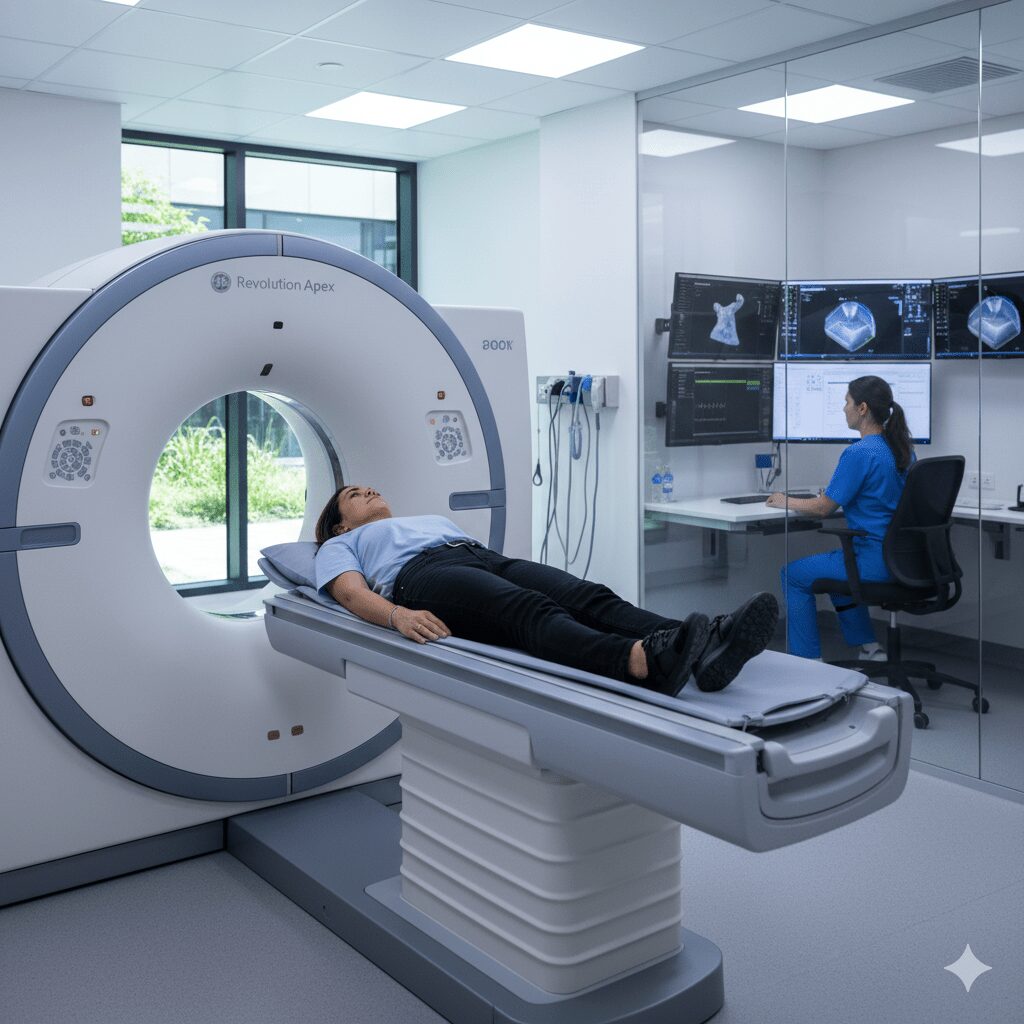
CT scan


Learn what a CT scan is, how the procedure works, its common uses, and the safety concerns related to radiation exposure.
For those who have had severe health conditions like bone injuries or cancer, you have probably undergone a CT scan. So, what is a CT scan?
A CT scan, also known as computerized tomography, is a type of imaging technique that uses X-rays to generate a detailed image of the body. [1]
Compared to a plain X-ray, a CT scan tends to show images that are clear and well-detailed, hence guiding medical experts in recommending appropriate treatment.
A CT scan can be used for several purposes. This technique can be used to diagnose a disease or injury. It can also be used to plan medical, surgical, or radiation treatment.
How Does a CT Scan Work?
A CT scan works by using a rotating X-ray tube to send X-ray beams through the patient. Sensors then detect the beams opposite the source.
A computer then processes these beams to generate a detailed, cross-sectional 2D image of the body. The generated data can also be stacked to form a 3D representation for diagnosis and treatment planning. [2]
This involves a series of processes:
- A patient lies in a motorized table that gradually extends to the large, donut-shaped CT scanner.
- X-ray emission. The CT scanner emits beams of X-rays from various angles through the body.
- Data collection. Digital X-ray detectors capture the X-rays that have passed through a patient’s tissues.
- Computer processing. The computer receives the X-ray data and generates it into a series of 2D cross-sectional images.
- 3D imaging. The 2D slices are then digitally stacked to generate a detailed and precise 3D image of the area being examined.
Common Uses of CT Scans
A CT scan can be used to diagnose several health conditions. Diagnostic uses of a CT scan include:
- Trauma and injury. Medical experts can use a CT scan to detect bone fractures, internal bleeding, and other injuries. [3]
- A CT scan can be used to find, diagnose, and monitor the progress of abnormal growth in the body.
- Neurological conditions. The purpose is to diagnose brain issues like tumors or hemorrhages.
- Vascular problems. A special scan, CT angiography, is used to assess blood blockages or other issues.
- Infections and inflammation. A CT scan can be used to diagnose infections or inflammation in various body parts.
- Organ and tissue health. The health of the body’s organs, such as the kidneys, can be diagnosed with conditions like kidney stones.
What to Expect During a CT scan
During a CT scan appointment, ensure you follow every guideline issued by your healthcare professional. This is necessary for your safety and the success of the procedure.
Before the scan, your medical expert may recommend that you wear a hospital gown or change into a more comfortable outfit. If you are allergic, inform your medical expert before the procedure. Also, avoid solid food for some hours if you are receiving contrast dye.
During the scan, you will lie on the scanner as recommended by your healthcare expert. As the machine rotates around you, it will make some whirring sounds. Additionally, your doctor may ask you to hold your breath for a few seconds to prevent image blur.
After the scan, your radiologist will interpret the images and send the report to your doctor, who will later discuss the results with you.
Are CT scans Safe?
CT scans are generally considered safe. However, having frequent CT scans can put you at greater health risks. This typically arises from radiation exposure. In fact, a publication at Harvard Medical School noted that multiple CT scans increased the risk of cancer in the United States from 2.7% to 12%. [4]
Rebecca Smith-Bindman, MD, is a Professor in Residence of Epidemiology and Biostatistics, Obstetrics, Gynecology, and Reproductive Medicine. She notes that “Reducing the number of scans and reducing doses per scan would save lives.” [5]
Bottom Line
CT scans play an important role in modern medicine. The procedures help medical experts diagnose infections, head injury, abnormal tissue problems, cancer, or inflammation. With the help of advanced computers, healthcare professionals can interpret X-ray data and recommend appropriate treatment.
While CT scans are generally considered safe, frequent scans can prove dangerous. Due to radiation exposure from CT scans, multiple scans can lead to potentially life-threatening conditions like cancer.
To ensure you are on the safe side, limit CT scan radiation exposures. Also consult your healthcare provider for further guidance.
Sources
- Mayo Clinic. CT Scan. Mayo Clinic. Published May 7, 2024. https://www.mayoclinic.org/tests-procedures/ct-scan/about/pac-20393675
- John Hopkins Medicine. Computed Tomography (CT) Scan. John Hopkins Medicine. Published 2023. https://www.hopkinsmedicine.org/health/treatment-tests-and-therapies/computed-tomography-ct-scan
- Márcio Luís Duarte, Ribeiro L, Souza A, Wagner Iared, Maria Stella Peccin. Computed tomography with low-dose radiation versus standard-dose radiation for diagnosing fractures: systematic review and meta-analysis. São Paulo medical journal. 2021;139(4):388-397. doi:https://doi.org/10.1590/1516-3180.2020.0374.r3.1902021
- Harvard Health Publishing. Radiation Risk from Medical Imaging. Harvard Health. Published September 30, 2021. https://www.health.harvard.edu/cancer/radiation-risk-from-medical-imaging
- University of California, San Francisco. Popular CT Scans Could Account for 5% of All Cancer Cases A Year. Popular CT Scans Could Account for 5% of All Cancer Cases A Year | UC San Francisco. Published April 14, 2025. https://www.ucsf.edu/news/2025/04/429791/popular-ct-scans-could-account-5-all-cancer-cases-year




Comments are closed.